










Nonprofits often face the challenge of standing out at events while working within tight budgets. Custom event signage can be a cost-effective way to boost visibility, communicate your mission, and leave a lasting impression. Nearly 48% of people associate signage with brand recall, and 79% believe it reflects organizational quality. With smart design and material choices, you can create professional signage without overspending.
Key Takeaways:
- Affordable Options: Vinyl banners, feather flags, retractable banners, branded table covers, and A-frame signs are budget-friendly and reusable.
- Smart Design Tips: Use simple layouts, high-contrast colors, and clear fonts. Leverage free tools like Canva or Adobe Express for professional results.
- Stretch Your Budget: Order in bulk, choose durable materials, and partner with printers offering nonprofit discounts.
- Maximize Impact: Place signs strategically, reuse designs across events, and store them properly to extend their lifespan.
Custom signage is an investment that enhances your nonprofit’s credibility while driving engagement at every event.
Budget-Friendly Signage Options for Nonprofits
Creating effective signage doesn’t have to drain your nonprofit’s budget. By making smart design and material choices, you can achieve maximum impact without overspending. The goal is to select signage that fits your specific needs while keeping costs in check. Let’s explore some affordable signage options that deliver visibility and value.
Types of Low-Cost Signage That Work
Vinyl banners are a versatile choice for both indoor and outdoor events. They’re durable enough to withstand the elements and can be easily rolled up for storage between uses. If your organization hosts multiple outdoor fundraisers, vinyl banners are a cost-effective investment that can be reused year after year.
Feather flags are perfect for grabbing attention in high-traffic areas like roadways or parking lots. Their movement in the wind naturally draws the eye, making them ideal for directing attendees or highlighting event entrances. With prices starting under $50, they’re an affordable way to enhance your event’s visibility.
Retractable banners shine at indoor events. These sleek, professional displays are quick to set up and compact for storage. They work especially well at entry points or beside registration tables, with costs typically ranging from $125 to $275.
Table covers are a simple way to transform plain folding tables into branded displays. Starting at $55, they’re a great addition to health fairs, community festivals, and recruitment events, helping your booth stand out while projecting a polished image.
Pop-up A-frame signs are both sturdy and portable, making them a great choice for directional signage, sponsor shout-outs, or program promotions. They’re easy to transport, making them ideal for organizations setting up at farmers markets, school events, or community gatherings.
For smaller-scale needs, yard signs are a steal at just $9 and up. These are perfect for directing attendees to parking, restrooms, or specific activity zones during larger events.
If your event is in a windy location, mesh banners are a smart alternative to standard vinyl. Although they cost slightly more, their perforated design prevents billowing and reduces the risk of damage in gusty conditions.
Next, we’ll look at how Peak Banner’s custom solutions can stretch your signage budget even further.
Peak Banner‘s Low-Cost Solutions
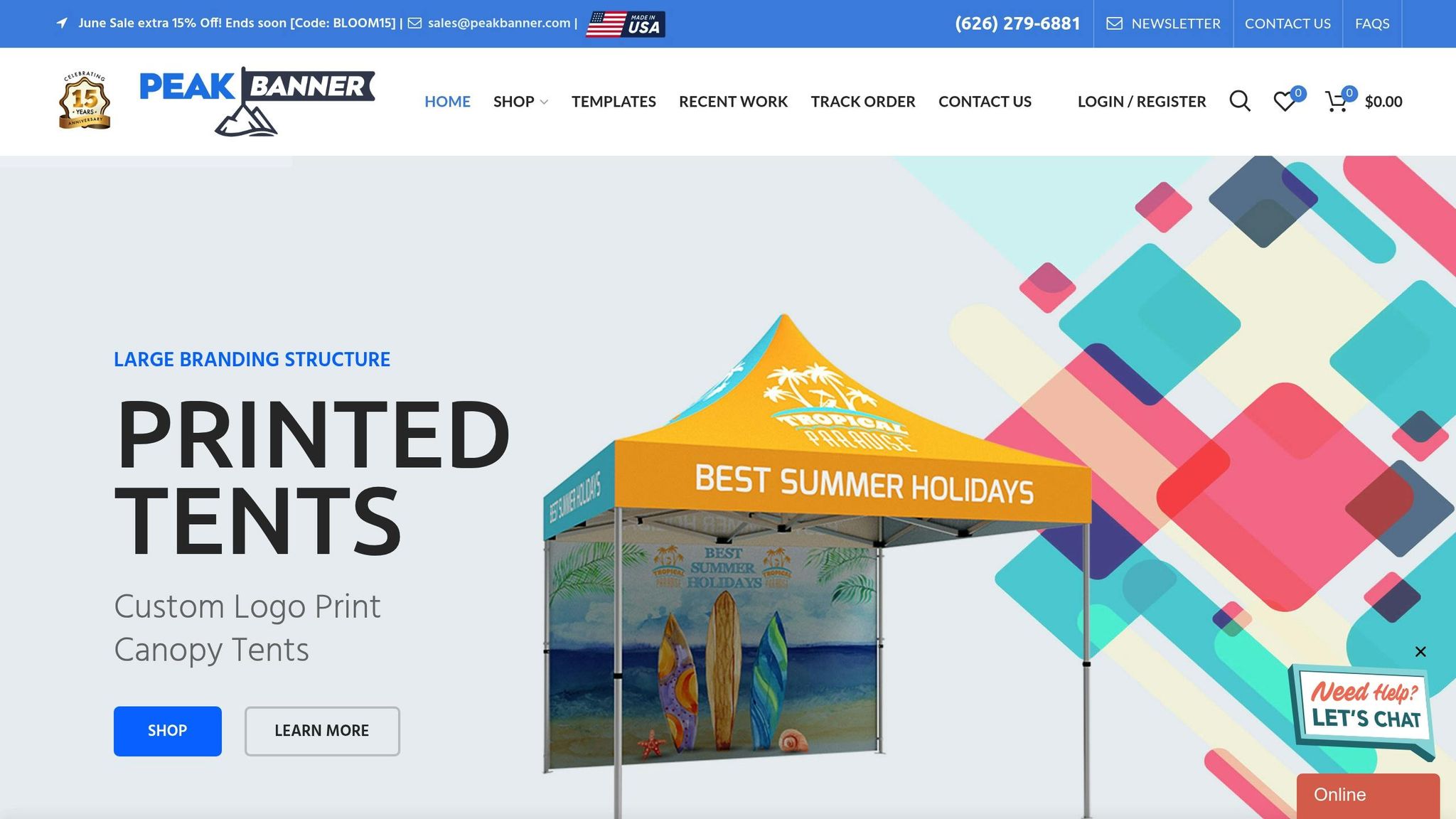
Peak Banner specializes in affordable products tailored to nonprofit needs, ensuring every marketing dollar goes further.
Their custom logo canopy tents, starting at $185, provide a combination of brand visibility and practical shelter. These tents not only protect your team and materials from the elements but also serve as a professional centerpiece that draws attention from across the event space.
Feather flags, starting at $49, are another cost-effective option. These lightweight, easy-to-set-up signs can be repositioned throughout your event to guide traffic or highlight different activities.
For nonprofits hosting multiple events, Peak Banner’s event bundles are a great deal. Starting at $795, these packages typically include a mix of signage types, ensuring cohesive branding while offering savings compared to purchasing items individually.
Their branded table covers, starting at $55, elevate the look of any display. Whether you’re collecting donations, signing up volunteers, or sharing information, a custom table cover adds a professional touch that enhances your organization’s credibility.
With in-house production, Peak Banner offers quick turnaround times and customized solutions that meet both your event needs and your budget. This direct approach also helps cut costs, passing savings on to nonprofits that rely on every dollar to support their mission.
The secret to stretching your signage budget is choosing pieces that can serve multiple purposes and be reused across various events. A well-made banner or canopy tent, for example, can seamlessly transition from a summer fundraiser to a winter market, maximizing your investment over time.
Design Tips for High-Impact, Low-Cost Signage
Creating eye-catching signage doesn’t have to break the bank. The secret lies in smart design. A well-crafted sign can stand out and communicate effectively by following a few fundamental principles. Here’s how you can design professional signage that grabs attention and delivers your message clearly.
Basic Design Rules for Clear, Readable Signs
Simplicity is key. A sign should communicate one clear message without overwhelming the viewer. As Byers Creative explains:
"Visuals should simplify your message, not complicate it."
Avoid clutter to keep your message instantly understandable.
Establish a visual hierarchy. Stick to no more than two clean, sans-serif fonts. Use larger text for the main message and smaller text for supporting details. This makes your sign easy to read, even from a distance.
Pick high-contrast colors to boost readability. For example, black text on a yellow background is highly legible, while white text on red can be harder to read at a glance.
Leverage white space. To enhance clarity, aim for a 40% content to 60% negative space ratio. According to the United States Sign Council Foundation, this balance improves readability.
Add a border for impact. Borders can increase reading speed by up to 25%, helping viewers absorb your message more quickly.
Test before printing. Always view your design at different distances and angles to ensure it translates well from screen to full-scale print.
Once you’ve mastered these design basics, the next step is to use affordable tools to bring your ideas to life.
Free and Low-Cost Design Tools
You don’t need expensive software to create professional-looking signage. Plenty of free and budget-friendly tools can help, including:
- Canva: Offers a free version and special nonprofit pricing for Pro accounts. It features templates, stock images, and an intuitive drag-and-drop interface.
- Adobe Express: Provides a free version, with premium features available at no cost for nonprofits.
- VistaCreate: Includes both free and paid plans, with Pro plans offered for free to eligible nonprofits. Its modern templates are perfect for standout signage.
- DesignMantic: Specializes in free logo design services for nonprofits, making it a great resource for professional branding.
- Pixlr: A browser-based tool that mimics Photoshop’s features, offering easy-to-use options for basic signage design.
Choose a platform that matches your team’s comfort level and the type of signage you plan to create.
Creating Reusable Designs for Multiple Events
Once you’ve nailed your design, consider ways to make it reusable. This ensures your signage remains effective and cost-efficient across various events.
Focus on core branding. Build templates that highlight your logo, colors, and mission statement. This keeps your branding consistent while allowing you to update event-specific details easily.
Design modular signage. Create signs with interchangeable elements. For example, use a banner template featuring your organization’s name and logo, and leave space for event-specific information. You can update dates or locations using removable elements or document sleeves.
Incorporate changeable features. Chalkboards, dry-erase boards, or printed inserts are great for frequently updated information. These options let you refresh details without reprinting your main signage.
Collaborate with your team. Work with your design team or volunteers to develop a visual identity system that works across events and seasons. This approach not only saves money but also aligns with sustainable practices many nonprofits value.
How to Save Money on Printing and Materials
Once you’ve nailed down a strong design, the next step is finding ways to cut costs on printing and materials. By choosing the right materials and partnering with reliable printers, you can keep expenses low without sacrificing the quality of your signage. It’s all about knowing what works best for your needs and budget while building long-term relationships with suppliers.
Choosing Budget-Friendly Materials
When it comes to materials, the right choice can make all the difference in balancing cost and durability. Here are some options to consider:
- Vinyl banners: These are tough, weather-resistant, and reusable, making them a great value for long-term use.
- Corrugated plastic (coroplast): Lightweight and affordable, this is perfect for temporary signage needs.
- PVC foam board: A durable option that works indoors and outdoors, resisting harsh weather and UV rays. Prices start at just $26.95, making it a solid mid-range choice.
Your decision should factor in how long the sign will be used, the local weather, and your budget. For one-time events, corrugated plastic is ideal, but for signage you’ll use repeatedly, materials like PVC foam board or aluminum are worth the investment. Research even shows that small businesses using affordable signage with clear designs can boost foot traffic by 30% – and 76% of consumers have visited a store based solely on its signage.
Partnering with the Right Printer
A dependable printing partner can help you save money while ensuring your signage looks professional. Look for companies that cater to nonprofit organizations, offering competitive pricing and reliable service.
- Peak Banner provides custom branding solutions with quick turnaround times and nonprofit-friendly pricing.
- Many printers, like Printix, offer nonprofit discounts. For instance, Printix gives verified nonprofits a 30% discount, which can significantly reduce costs.
- Request free sample packets before placing large orders. This allows you to check the material quality and print clarity in advance.
Some companies, like Connected Office Technologies, also offer full-service solutions that simplify the process. As they explain:
"Connected Office Technologies gives nonprofit organizations access to affordable, high-quality printing solutions that make a difference."
Using one provider for all your signage needs can help you secure better pricing and maintain consistent quality. Additionally, bulk orders can further reduce costs, so it’s worth planning ahead.
Bulk Orders and Event Bundles: A Smart Way to Save
Ordering in bulk is one of the easiest ways to cut printing costs. Thanks to digital printing technology, even small batches are now affordable, while larger orders benefit from volume discounts.
- Digital printing can save 25–40% compared to traditional methods. For example, posters in quantities of 100 cost about $1.50 each, and full-color flyers can be as low as $0.15 per page for runs of 500.
- Black-and-white copies are even cheaper, ranging from $0.05 to $0.10 per page for orders of 1,000.
Nonprofits that plan strategically can see real savings. Take these examples:
- A youth mentoring group in Oregon cut its annual print bill from $1,200 to $700, saving $500 for field trips.
- A women’s shelter saved $200 on 1,000 flyers, which helped fund essential bedding for new residents.
Planning for multiple events at once can maximize your savings. For instance, the Coastal Cleanup Crew in California printed 500 full-color flyers and 50 posters for just $125, successfully rallying 200 volunteers for a beach cleanup.
Here’s a quick cost breakdown for common sizes:
| Size | Cost (per 100) | Best Use |
|---|---|---|
| 8×10 | $75 | Handouts, small venues |
| 12×18 | $150 | Event signage, walls |
Annual planning can also help stretch your budget. A rural health clinic in Nebraska switched to digital black-and-white copies for patient intake forms, saving $800 over a year.
Maria Torres, a print shop manager, highlights the benefits of digital printing:
"Charities love digital because it’s fast and scalable. You’re not locked into huge orders, and quality stays crisp."
This flexibility ensures you only order what you need, avoiding waste while still taking advantage of volume pricing to support your nonprofit’s mission.
sbb-itb-c623e60
Getting the Most from Your Event Signage
Creating standout signage is just the first step. To make the most of your nonprofit’s investment, you’ll want to think carefully about how to use those signs before, during, and after your event. With strategic placement and proper care, your signage can become a long-term resource for your organization.
Using Signage to Promote Events Before They Happen
Your event signage doesn’t need to sit idle until the big day. By using banners and signs in advance, you can build excitement and boost attendance. Placing promotional banners in high-traffic areas – like community centers, libraries, grocery stores, or busy intersections – can create early buzz around your event. As Ted Pallota notes:
"People give to causes they care about. Help them connect."
To make your pre-event signage effective, focus on bold visuals and concise messaging. Start by revisiting your nonprofit’s mission and event goals, then tailor your message to resonate with your audience. Include a clear, action-oriented call to action that motivates people to get involved. These small steps can help generate momentum that carries over to your on-site signage.
Where to Place Signs for Maximum Visibility
Once your event is underway, well-placed signage can make a big difference in how smoothly everything runs. Directional signs help guests navigate the venue, reduce stress on volunteers, and improve the overall experience. When it comes to signage, it’s better to have too much than too little.
Here are a few placement tips to ensure maximum visibility:
- Use freestanding displays on both sides of hallways and near multiple access points to ensure guests can easily spot directions without blocking traffic.
- For outdoor events, attach banners to fences to guide attendees.
- Use floor graphics to direct traffic and ensure smooth movement throughout the venue.
- Place checkout or pickup signs near natural exit points, such as the end of a ballroom or main session area.
Large events like Dreamforce and The Presidents Cup are great examples of how creative sign placement can enhance navigation and engagement. Thoughtful positioning not only ensures guests know where to go but also contributes to a seamless event experience, setting the stage for future reuse.
Storing and Reusing Signage After Events
Taking care of your signage after the event ensures it stays in great shape for future use. For soft signage, roll it up and store it in sturdy tubes with clear labels. Protect rigid signs with padded cases, and place non-stick paper between rolled signs to prevent ink from transferring. Keep all hardware – like poles and stands – organized in labeled cases.
Store your signage in a cool, dry, and shaded space to avoid damage. Avoid stacking items too high to prevent dents or creases; horizontal racks, vertical bins, or hanging storage (for fabric banners) are ideal. Inspect your signage every few months to catch any signs of wear or mold. To make your signs even more versatile, consider design features like vinyl letter decals or magnetic overlays, which allow you to update dates or themes for different events. With proper care and a little creativity, your signage can serve your organization for years to come.
Key Points for Nonprofit Event Signage Success
Creating effective and affordable event signage starts with smart planning. Nonprofits that focus on affordability, ease of use, durability, and quick setup can enhance their visibility without exceeding their budget. By prioritizing these factors, organizations can maximize impact while keeping costs in check.
One of the best ways to stretch a signage budget is to opt for reusable materials. Items like retractable banners and branded tablecloths can be used repeatedly for various events, helping to lower long-term expenses and cut down on waste. This strategy is both cost-effective and environmentally conscious.
Beyond being reusable, signage should serve multiple purposes. A well-designed sign not only promotes events but can also engage audiences with features like QR codes that link directly to donation pages or volunteer sign-up forms. Since visuals are processed five times faster than text, using clear, compelling images instead of cluttered designs ensures your message gets across quickly and effectively.
Another way to save money is through strategic sourcing. Modular signage with interchangeable components can adapt to different campaigns, reducing the need for entirely new materials. Sustainable options, such as recycled paper and eco-friendly inks, are often less expensive than premium materials and align with environmentally responsible practices. Ordering in bulk or purchasing event bundles can also provide additional savings.
Where you place your signage is just as important as its design. With only 15–20% of signs being noticed and an average viewing time of less than two seconds, positioning signs in high-traffic areas – like near entrances, exits, or corners – can significantly boost visibility. Thoughtful placement amplifies the impact of your signage while keeping costs low.
FAQs
How can nonprofits design reusable and cost-effective signage for events?
When working on signage that’s easy on the wallet and reusable, prioritize versatile designs and long-lasting materials. Skip adding details like specific dates or event names, and instead, go for removable decals or overlays to keep your messaging flexible. Choose eco-conscious options like durable foam boards or corrugated plastic, which are built to handle repeated use. Another smart move? Modular designs – these can be adjusted or rearranged to fit different event layouts, giving you a polished look without breaking the bank.
How can nonprofits save money on custom event signage by working with printers or forming partnerships?
Nonprofits looking to cut signage expenses have several smart options to consider. One effective approach is partnering with printers that offer discounted rates exclusively for nonprofit organizations. By providing proof of your nonprofit status, you can often access these special deals, which can make a big difference to your budget.
Another strategy is joining cooperative purchasing programs. These programs let nonprofits tap into bulk discounts that are usually reserved for large orders. On top of that, cultivating long-term relationships with printing companies can unlock perks like exclusive offers or loyalty discounts. This way, you can keep costs down while ensuring your event signage gets the attention it deserves.
How can nonprofits store and care for event signage to make it last longer and stay reusable?
To keep your event signage in good condition and ready for reuse, store it in a cool, dry place away from direct sunlight, excessive humidity, or extreme temperatures. Before storing, make sure your signs are clean and completely dry to avoid any potential damage. For signs made from flexible materials, roll them up rather than folding to prevent creases.
Use sturdy shelving or flat storage surfaces to avoid bending or warping. It’s also a good idea to check your signage periodically for any signs of wear or damage. With regular cleaning and careful handling, your signs will stay in top shape and be ready to shine at your next event.