










Feather flags are a cost-effective outdoor advertising tool that grabs attention with their height, movement, and vibrant designs. Unlike billboards, which can cost $500–$2,000 for three months, feather flags are a one-time purchase ranging from $90–$450 for three flags. They’re versatile, portable, and easy to set up in under five minutes, making them ideal for storefronts, events, and roadside promotions. Here’s what you need to know:
- Material & Durability: Opt for 110–115g knitted polyester with UV and water-resistant coatings. For windy areas, mesh polyester reduces wind stress by 50%.
- Printing Options: Single-sided flags are lightweight and cost-effective, while double-sided options provide clear visibility from both sides.
- Size Selection: Choose based on location:
- 8.5 ft: Small spaces, readable up to 60–100 ft.
- 12 ft: Storefronts, visible up to 180 ft.
- 15–18 ft: Highways, readable up to 360 ft.
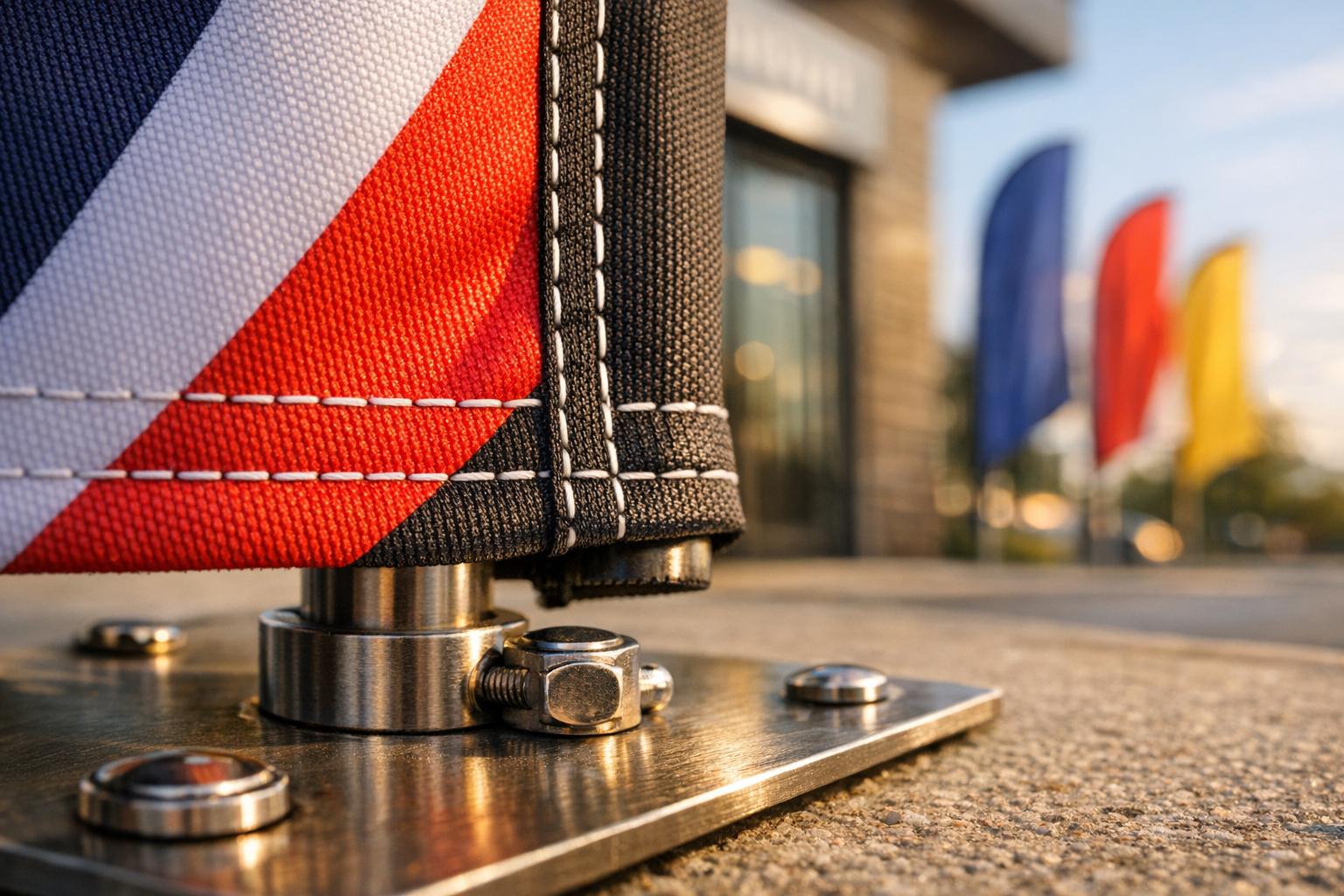
- Hardware: Fiberglass poles are durable and flexible, with bases like ground spikes or water-filled options for stability.
- Maintenance: Hand wash every 2–3 months, store dry, and protect against extreme weather for a lifespan of 1–3 years.
Peak Banner offers custom feather flags starting at $49 with free design assistance and bulk discounts. With proper care, these flags effectively boost visibility and last for years.
What to Look for in Quality Feather Flags
The durability of feather flags hinges on three main factors: material weight, fabric construction, and printing method. Paying attention to these details can save you from investing in low-quality flags that might look fine initially but fail when exposed to outdoor conditions. Here’s what you need to know to ensure your flags last.
Material Quality and Weather Resistance
For long-lasting performance, opt for 110–115g (≈4 oz) knitted polyester. This weight strikes the right balance between durability and flexibility. Thinner materials, like those in the 2–3 oz range, are prone to tearing. High-quality polyester with a Durable Water Repellent (DWR) coating is especially useful, as it prevents the fabric from becoming waterlogged during rain, which can strain the pole and cause sagging.
Another key feature is UV resistance. Top-tier flags can endure over 2,000 hours of direct sunlight based on ASTM G155 UV standards and boast colorfastness ratings of 4–5 under ISO 105-B02. This means you can expect vibrant colors to last around 2–3 years of outdoor exposure before noticeable fading occurs. Look for flags treated with UV-resistant stabilizers or coatings to maintain their brightness over time.
For windy or coastal areas, consider mesh polyester fabric. With a 30% open area, this material lets wind pass through, reducing stress on the pole by 50% compared to solid fabrics. Mesh designs are built to handle sustained winds up to 46 mph and gusts as high as 62 mph without compromising the flag or hardware.
Durability also depends on construction details. Prioritize flags with double-stitched edges, reinforced pole sleeves, and aerodynamic shapes like convex or teardrop designs, which reduce wind stress. Additionally, dye-sublimation printing ensures the ink is infused directly into the fibers, providing vibrant and long-lasting colors.
Single-Sided vs. Double-Sided Printing
When it comes to printing, the choice between single-sided and double-sided flags depends on your specific needs.
- Single-sided flags: These are lighter and allow for a 70–85% mirror-through effect on the reverse side. They’re perfect for locations where the flag will primarily be viewed from one direction, such as storefronts. Their lighter weight makes them more responsive to light breezes, which can help draw attention from a distance. They’re also more cost-effective.
- Double-sided flags: Constructed with two polyester panels and a 100% blackout mesh liner, these flags provide complete opacity and clear visibility on both sides. However, they’re heavier and require stronger supports.
"Double-sided flags are made by sewing two flags together with a 100% blackout mesh in the middle. This ensures complete opacity and added durability." – Feather Flag Nation
Single-sided flags are ideal for high-wind areas, as their lighter weight allows them to flutter more freely without putting extra strain on the pole. On the other hand, double-sided flags are better suited for intersections, parking lots, or events where you need visibility from multiple angles. Just keep in mind that their added weight calls for a sturdier base, such as a cross base with sand or water weights, to ensure stability.
sbb-itb-c623e60
How to Choose the Right Feather Flag Size
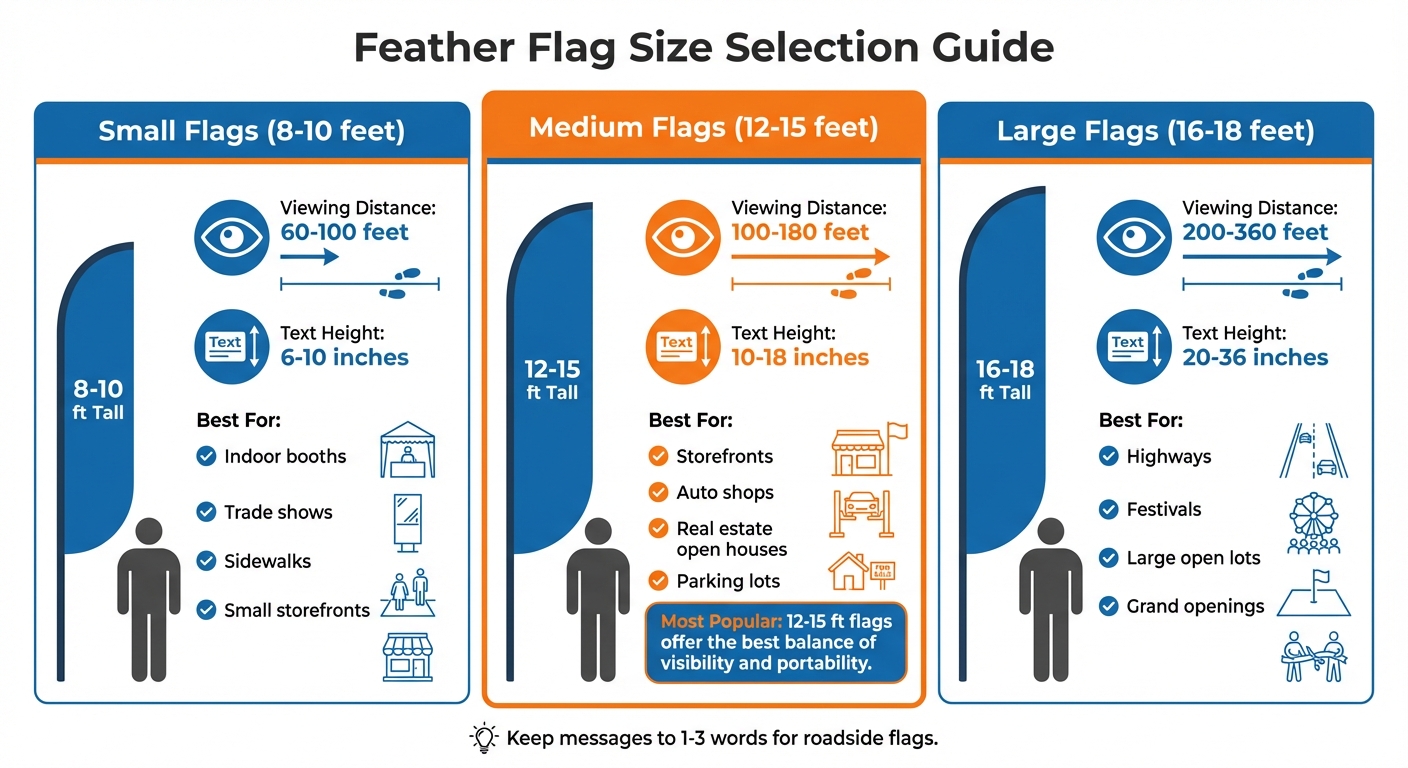
Feather Flag Size Selection Guide: Height, Viewing Distance, and Usage Comparison
Picking the right feather flag size is all about understanding your location and audience. While material quality and print clarity ensure your flag lasts and looks great, size plays a key role in grabbing attention. A flag that’s perfect for a cozy café might not cut it next to a busy highway.
The 12-foot flag (with a 15-foot pole) is a crowd favorite because it strikes a good balance between visibility and portability. It’s a solid choice for storefronts, auto shops, real estate open houses, and parking lots – places where you want to catch the eye of both pedestrians and drivers.
Before settling on a size, check for overhead obstacles like tree branches or power lines, and make sure you’re aware of any local rules – some areas have height restrictions for temporary signage. For roadside flags, keep your message short (five words or less) and use lettering that’s 10–18 inches tall for easy readability.
Here’s a breakdown of the best sizes for different scenarios, from compact indoor setups to attention-grabbing roadside displays.
8.5-Foot Flags for Small Spaces
If you’re working with limited space or targeting an audience within 30–60 feet, an 8.5-foot flag is a great pick. These smaller flags are perfect for indoor events, trade show booths, sidewalk promotions, or small storefronts where larger sizes might feel overwhelming or impractical. Typically, this setup includes a 6-foot flag on an 8-foot pole, giving you enough height without bumping into overhead fixtures.
For text, stick with 6–10 inch lettering and keep it simple. A logo, store name, or single-word message like "SALE" or "OPEN" works best at this scale.
11.5-Foot Flags for General Use
Mid-sized flags, around 11.5 feet tall, are versatile and work well in most outdoor settings. They’re tall enough to stand out above parked cars or moderate crowds, making them ideal for farmers markets, gas stations, strip malls, and community events. These flags offer a practical mix of visibility and ease of use, without needing heavy-duty anchors.
They’re perfect for short taglines or clear calls to action.
15-Foot and 18-Foot Flags for Maximum Visibility
When you need to grab attention from far away – think highways, large festivals, grand openings, or sprawling parking lots – go big with 15- or 18-foot flags. These larger flags, combined with 20–36 inch lettering, can be read from 200–360 feet, giving passing drivers just enough time to catch your message.
Because of their size, these flags need sturdy bases. For soft ground, use ground spikes, and for hard surfaces, opt for a cross base with water bags. Keep in mind that taller flags face more wind resistance, so make sure your location can handle it. For roadside use, stick to 1–3 word headlines that are easy to read at a glance.
Here’s a quick comparison to help you decide:
| Flag Height (with pole) | Usage | Viewing Distance | Text Height |
|---|---|---|---|
| 8–10 feet | Indoor booths, trade shows, sidewalks | 60–100 feet | 6–10 inches |
| 12–15 feet | Storefronts, auto shops, real estate | 100–180 feet | 10–18 inches |
| 16–18 feet | Highways, festivals, large open lots | 200–360 feet | 20–36 inches |
Print Quality Requirements for Outdoor Advertising
When it comes to outdoor advertising, clear print quality is just as crucial as size and durability. In the competitive U.S. market, sharp, vibrant prints ensure that your message grabs attention – even under bright sunlight. The print quality of your feather flag can make the difference between a message that stands out and one that fades into the background.
Resolution and Color Standards
To achieve professional, crisp visuals, aim for a minimum resolution of 150 DPI. This ensures that your images remain sharp and clear, even when viewed from a distance. For logos and other graphic elements, vector files are ideal since they can be scaled without losing clarity.
"For feather flags, we recommend using high-resolution images of at least 150 DPI to ensure your branding is clear and impactful from a distance." – Craig Noteboom, Co-founder of Banner World
Using dye-sublimation printing is another game-changer. This technique locks in vibrant colors while improving the flag’s durability. In June 2025, Lush Banners reported that businesses using flags printed at 150 DPI or higher experienced a 25% increase in customer inquiries during outdoor events. This highlights how print quality directly correlates with customer engagement.
Color accuracy is equally critical. Matching your flag’s colors to your brand ensures a polished, professional appearance. Polyester fabrics are particularly effective at holding dye, resisting fading, and maintaining consistent brand colors over time. For instance, in March 2023, LGI Homes in Texas used custom feather flags with precise brand colors and observed a noticeable uptick in foot traffic to their model homes. This proves that the right colors can significantly enhance visibility and draw attention.
Once you’ve nailed the print quality, the next step is to focus on designing for maximum outdoor visibility.
Design Tips for Outdoor Visibility
High-contrast color combinations are key to making your message stand out. Use dark text on light backgrounds or vice versa to ensure readability against various backdrops like trees, buildings, or the sky.
Stick to the "1 to 10 Rule": for every 1 inch of text height, your message should be readable from 10 feet away. For example, a 10-inch letter can be seen clearly from 100 feet, while a 20-inch letter works for 200 feet. Adjust your text size based on your flag’s height and the average viewing distance.
Keep messages short and impactful. Limit each line to 1–3 words for quick readability. Simple phrases like "SALE TODAY" or "OPEN NOW" are far easier to process at a glance than lengthy sentences. Use bold, sans-serif fonts, as they maintain clarity from a distance and don’t get lost in unnecessary details. While adding your logo is a great idea, avoid overcrowding the design with too many graphics or competing colors.
Here’s a quick summary of essential design tips:
| Design Element | Recommendation | Why It Matters |
|---|---|---|
| Image Resolution | 150 DPI minimum | Ensures sharp photos and graphics |
| Text Contrast | High contrast (dark on light or vice versa) | Improves readability in various lighting |
| Message Length | 1–3 words per line | Easy to read at a glance |
| Font Style | Bold, sans-serif | Stays clear from a distance |
How to Find Reliable Feather Flag Vendors
When it comes to feather flags, the quality of your vendor matters as much as the design itself. A reliable vendor ensures that your flag not only looks great but also stands the test of time. Take the time to research vendors thoroughly before placing an order.
In-House Production and Shipping Speeds
Vendors that manage their production in-house often offer quicker delivery and tighter quality control. By handling everything – printing, assembly, and packaging – these companies cut out middlemen and ensure every detail meets their standards. This efficiency often translates to faster shipping, typically within 2–5 business days, with some even offering same-day shipping for orders placed early in the day. To gauge a vendor’s reliability, ask about their production process, check delivery timelines, and read reviews that highlight fast turnarounds and consistent quality.
Peak Banner Feather Flags Starting at $49
Peak Banner offers custom feather flags starting at $49, striking a balance between affordability and high-quality materials. Their flags are crafted from 130g premium knit polyester and paired with reinforced fiberglass poles, which are far more durable than thinner alternatives.
One standout feature of Peak Banner is their in-house production process, combined with free professional design assistance. Customers can review digital mockups before printing, ensuring their logos and text are sharp and properly scaled. Production is typically completed within 2–3 business days, and most orders ship within 2–5 days.
"Our flags had great quality – thick poles and the print was vibrant on a durable flag material." – Ron S.
Peak Banner boasts a 5.00/5 customer rating, with reviews frequently praising the vibrant prints, sturdy poles, and attentive design support. One reviewer shared that their flags remained "super durable" after over a year of continuous outdoor use. For businesses needing multiple flags, bulk discounts make larger orders more budget-friendly without compromising on quality. This commitment to durability and precision makes Peak Banner a go-to choice for impactful outdoor advertising.
Hardware and Accessories for Outdoor Stability
To ensure your flag performs well outdoors, sturdy hardware is just as important as the materials and printing quality. The pole and base you choose can significantly influence how long your flag lasts and how well it handles outdoor conditions.
Pole Materials and Base Options
When it comes to poles, different materials offer distinct advantages:
- Fiberglass poles are known for their durability and ability to flex with the wind, reducing stress and preventing damage.
- Aluminum poles are lightweight, resistant to corrosion, and easy to transport, making them great for moderate weather, though they lack the flexibility of fiberglass.
- GRP (glass-reinforced plastic) poles stand out for their strength and wind-friendly design, as they rotate with the wind to minimize wear and tear. In fact, XG Group highlighted in 2023 that their GRP poles significantly extend the lifespan of feather flags by allowing free rotation.
"Using GRP poles extends the lifespan of your feather flag, as they are incredibly strong and designed to rotate freely." – XG Group
Choosing the right base is equally important, depending on where you’ll place your flag:
- Ground spikes are ideal for soft surfaces like grass, dirt, or mulch. Screw-in spikes provide extra anchoring for stability.
- Water-filled bases are perfect for hard surfaces like concrete or asphalt, adding 30–35 lbs of weight for reliable support.
- Cross bases are portable and versatile but may need weight bags for added stability outdoors.
- Flat iron bases work well for permanent setups, offering solid, dependable support.
Once you’ve selected your materials and base, wind resistance features can further improve your flag’s durability.
Wind Resistance Features
Fiberglass poles are particularly effective in windy environments. Single-sided flags can handle sustained winds up to 46 mph, while double-sided flags can withstand winds up to 63 mph. Their flexibility allows them to absorb wind forces without breaking. Pairing these poles with 4 oz polyester fabric adds another layer of durability, as this material resists tearing even under tough conditions. NorthCoast Banners reported in January 2026 that their 4 oz polyester flags lasted between 6 to 12 months outdoors in consistently windy areas due to their robust construction.
For extreme weather, it’s best to bring your flags indoors to prevent unnecessary wear and tear.
Placement and Maintenance for Long-Lasting Flags
Once you’ve chosen high-quality flags and sturdy hardware, where and how you place them – and how you care for them – can make a big difference in their lifespan.
Placement matters. Position your custom printed outdoor feather flags in spots with lots of foot or vehicle traffic, ensuring they’re visible and aligned with the flow of movement. For example, in 2026, a local business placed their flags near a busy intersection, facing oncoming traffic. The result? A 30% boost in foot traffic over just two months. Avoid areas where buildings, parked cars, or other signs could block visibility, and keep the flags at eye level for maximum impact.
Weather and environment also play a big role. To protect your flags, make sure ground spikes are installed with the spike head above ground level. This allows the flag to rotate freely with the wind, reducing wear and tear. Always store flags in a cool, dry place to prevent mold or mildew, and keep them dry before putting them away. During harsh weather – like winds over 40 mph, heavy rain, or snow – take the flags down to avoid unnecessary damage.
Care and cleaning are just as important. Hand wash your flags every 2–3 months with mild soap and water to remove dirt and pollutants. If you opt for machine washing, use a gentle cycle, but never machine dry or iron them. After washing, make sure the flags are completely dry before folding and storing. For added protection, consider using a UV spray to prevent fading, especially if your flags are exposed to direct sunlight for long periods. Regular maintenance like addressing loose stitching or fraying right away can help your feather flags last 1–3 years, while poles often last between 3–10 years, depending on how they’re used and the conditions they face.
Conclusion
Success with outdoor advertising using feather flags boils down to a few essential elements: durable 130g–150g knitted polyester, vibrant dye-sublimation printing, flexible fiberglass poles, and selecting the right size for your needs. By choosing high-quality materials and designs, you’re not just enhancing your brand’s visibility – you’re making a smart investment that saves money over time.
"Custom flag banners help your brand message last and communicate effectively with your customer. Don’t settle for cheap alternatives just to save a few dollars – they’ll cost you much more in the long run." – Lush Banners
Peak Banner offers custom feather flags starting at $49, complete with free design assistance and visual mockups delivered in just two hours. Whether you need a compact 8-foot flag for a storefront or a larger 16ft feather flag to grab attention along a busy road, there’s an option to suit your budget and goals. With proper care, these flags can last 1–3 years, while the poles often remain sturdy for 3–10 years.
If you’re ready to make a lasting impression, check out Peak Banner’s customizable options. Their perfect 5.00/5 customer rating highlights the quality and value they provide. Opt for materials and vendors that ensure your brand stays visible and professional for the long haul.
FAQs
How do I choose the right base for my location?
To pick the best base for your feather flags, think about where you’ll be displaying them. A ground spike base is perfect for soft surfaces like grass or soil. If you’re setting up on a flat, hard surface, a cross X base is a better choice. For outdoor setups where extra stability is needed, consider a water weight X-base cover, which is easy to transport and helps anchor the flag. Always choose a base that suits your location and can handle the weather, especially wind conditions, to ensure everything stays secure.
What wind speed is too high to leave a feather flag up?
Feather flags aren’t built to withstand wind speeds over 30 mph. Prolonged exposure to high winds can cause damage to both the flag and its supporting hardware. For the sake of safety and longevity, it’s best to take your feather flag down during strong winds or stormy weather.
What should I ask a “near me” vendor before ordering?
When buying feather flags from a local supplier, it’s important to ask the right questions to get the best results. Start by checking the materials – look for durable polyester paired with UV-resistant inks to make sure the flags can handle outdoor conditions. Ask about the range of sizes, styles, and hardware options, such as ground spikes or cross bases, to ensure stability in different settings.
Don’t forget to discuss print quality. Find out if they offer single or double-sided printing and how well they can match your design. Customization options are key to ensuring your branding or message looks exactly how you envision it. These considerations will help you get flags that work perfectly for your outdoor advertising goals.